
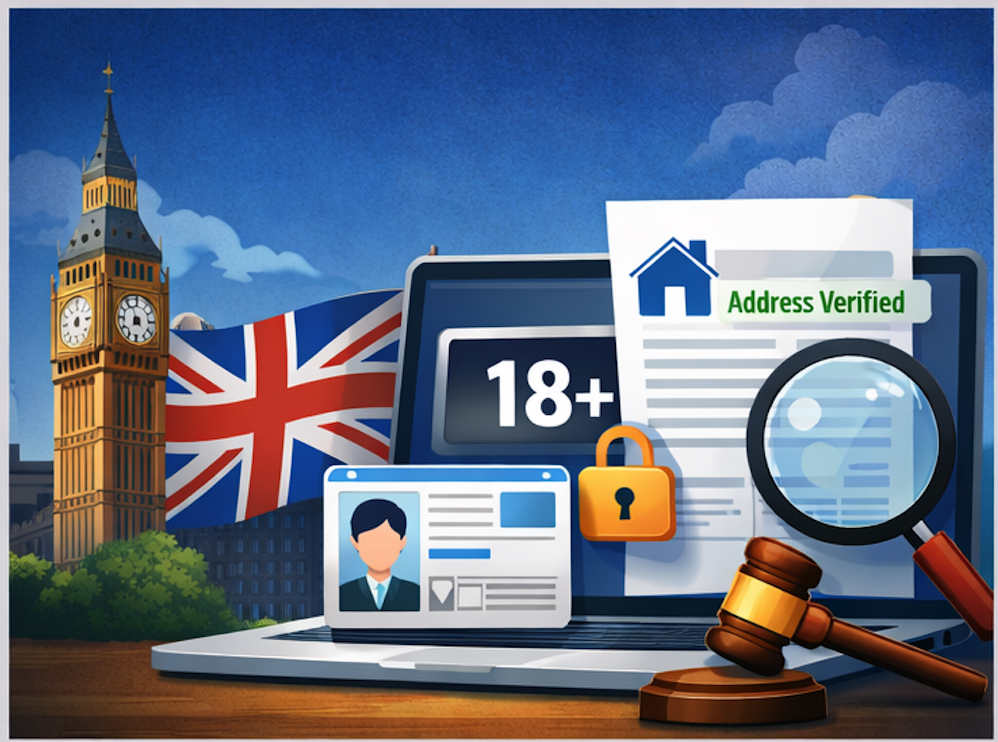



Understanding UK Age Verification Law and the Growing Importance of Proof of Address


Digital businesses operating in the United Kingdom are facing increasing regulatory pressure to strengthen their identity verification processes. The UK age verification law has become a key compliance requirement, especially for platforms offering age-restricted products and services. At the same time, proof of address has emerged as a critical supporting element in building secure and compliant onboarding systems.
The regulatory landscape in the UK is evolving rapidly. Authorities are focused on protecting minors from accessing harmful or restricted content, while also ensuring businesses meet robust Know Your Customer (KYC) standards. As a result, companies must adopt comprehensive identity verification frameworks that combine age checks, document verification, and address authentication.
The UK age verification law requires businesses in certain industries to confirm that users meet minimum age thresholds before granting access to services. This is particularly relevant for online gambling platforms, e-commerce websites selling restricted goods, fintech platforms, and digital content providers. Simply relying on self-declared age is no longer sufficient. Regulators expect businesses to implement reliable verification systems that reduce the risk of underage access.
However, verifying age alone is not always enough. Many regulated sectors also require confirmation of an individual’s residential status. This is where proof of address plays a central role. A valid proof of address document, such as a utility bill or bank statement, strengthens identity verification processes by confirming that the individual resides where they claim to live. This becomes especially important in financial services, where anti-money laundering (AML) rules demand higher levels of customer due diligence.
For businesses operating in the UK market, integrating proof of address verification into age verification workflows offers multiple advantages. First, it enhances regulatory compliance by satisfying both age-related and identity-related obligations. Second, it reduces fraud risks. Fraudsters often manipulate basic identity checks, but adding address verification increases the complexity of fraudulent attempts. Third, it builds trust with regulators and customers alike.
The implementation process requires a balance between security and user experience. Overly complicated onboarding systems may lead to higher drop-off rates. On the other hand, weak verification exposes businesses to penalties and reputational damage. Modern verification providers now use AI-powered document analysis and database cross-checks to verify proof of address documents within seconds, minimizing friction while maintaining compliance standards.
Another important factor is data privacy. Businesses must ensure that any collection of address documentation complies with UK data protection laws. Storing sensitive personal information without proper safeguards can create legal risks. Therefore, encrypted storage, limited retention policies, and secure transmission protocols are essential components of a compliant system.
From an SEO and content strategy perspective, targeting topics around UK age verification law and proof of address allows businesses to capture regulatory-driven search intent. These keywords attract compliance officers, legal teams, fintech startups, and platform operators who are actively looking for solutions.
As regulatory enforcement increases, proactive compliance becomes a competitive advantage. Businesses that invest early in robust verification frameworks can scale more confidently into regulated markets. Instead of reacting to enforcement actions, they position themselves as responsible operators aligned with legal standards.
In conclusion, the UK age verification law is reshaping digital onboarding requirements across industries. At the same time, proof of address verification strengthens compliance frameworks and reduces fraud risks. Businesses that combine both elements into a unified identity verification strategy will not only meet regulatory expectations but also enhance trust, security, and operational efficiency in the UK market.