







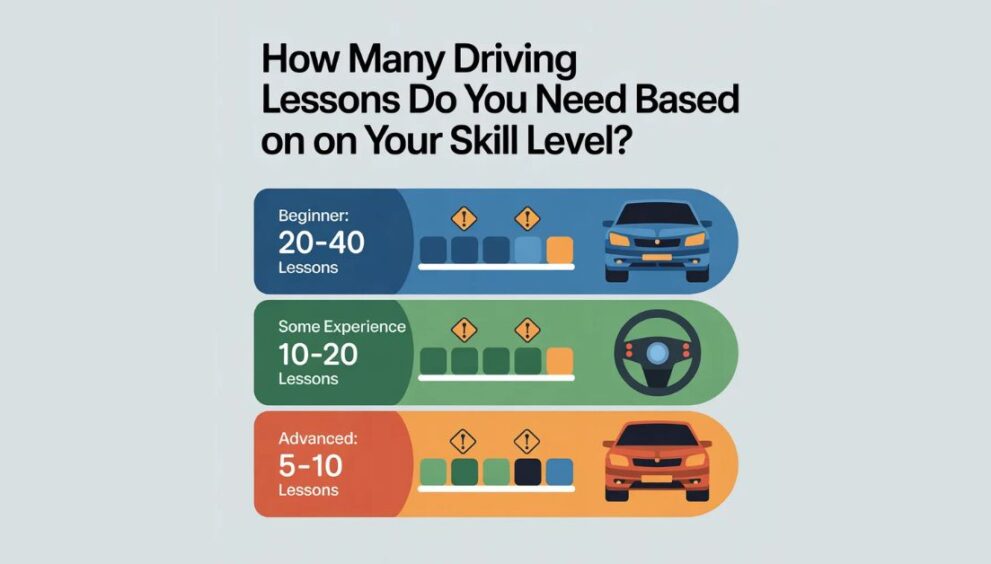
How Many Driving Lessons Do You Need Based on Your Skill Level?

Did you ever hear anybody say they took their driving exam and failed after only a couple of lessons, and someone else had to take months before they mastered it? It is this opposition that causes anxiety and confusion to new learners and experienced drivers. The fact is simple and can be easily misconstrued: the amount of driving lessons you require is mostly determined by your level of skills, not by some standardized one. This paper is structured into steps of How Many Driving Lessons Do You Need requirements and starts with total beginners and progress to more advanced drivers. You will also find out how much the level of skills determines the number of lessons, what is known about modern driving, and how to establish achievable expectations on the way.
Learning about Driving Skill Levels
However, before estimating the number of lessons, one should understand what a skill level is in driving. The level of skill is not only about the knowledge of how to drive the car. It involves awareness, reaction, judgment, confidence, and an ability to deal with any road situation that is not predictable. A beginner can be bad with coordination and road signs, and an intermediate learner may be a good driver but he/she can panics in case of pressure. The advanced drivers are usually familiar with the regulations but require polishing to pass the test standards. The degree of formal training required at each of the levels differs.
Novice Drivers: Coming into Nothing
Novice drivers do not always possess experience on the road. To them, it is all new including steering control as well as mastering traffic regulations. The initial training is maintained on a very minimal level of knowledge like the clutch control or accelerator balance, steering precision, mirrors and simple road positioning. The advancement might be slow at this point as the brain is multitasking.
Recent statistics of driving education indicate that the majority of novice drivers need between 30 and 45 professional sessions in order to achieve competence at the test level. This is the range since, as a beginner, one has to develop muscle memory and confidence over time. At the beginning of the lesson, the lessons tend to be shorter in duration due to the mental exhaustion. Efforts to err are normal, yet they are necessary in learning.
How to Be Confident: Beginner Edition
The factor of confidence is significant in the number of lessons a novice requires. Two students of equal ability may advance at very varying rates, according to the degree of relaxation with which they feel themselves. Frazil drivers are known to be slow since anxiety distorts decision-making. The contemporary instructor is now focusing on premeditated learning to minimize stress. Research findings in the psychology of drivers indicate that students who have a sense of safety and support learn faster at a rate of 20 percent compared to students who have a sense of rush and judgment. It implies that emotional preparedness will make it possible to cut the overall amount of lessons required.
In Between Drivers: Beyond the Basics but Not Yet Ready
The intermediate drivers are already aware of the fundamentals. They are able to drive in a light traffic, control the car and obey the traffic rules. They might however fail to cope with tricky scenarios like roundabouts, highway merging, parallel parking, or cross roads. At this stage, lessons are changed in that learners are no longer taught on how to drive but they learn on how to drive well.
Intermediate learners require an average of 10 to 20 extra lessons in order to hone their talents. These teachings dwell on consistency, perception of hazards and making decision under pressure. The learners at this stage are frustrated by the fact that the progress is not as much conspicuous. It is the case that improvement is gained internally, in better judgment and more fluent reactions, not necessarily in terms of new skills.
Skill Gaps Reduce Lesson Time
Intermediate drivers usually do not know the accumulation of minor weakness. Delay in test preparation can always be due to hesitation at intersection points and improper judgment on speed or lack of checking the blind spots. Based on the recent road safety report, observation and not control of the vehicle have led to more than 40 percent failure in the driving test. This is the reason why intermediate drivers might require more lessons than anticipated even when they think they are fit.
Advanced Drivers: Preparation and Test Refinement
Highly skilled drivers often are highly experienced, having either undergone private teaching with their family or years of informal experience. They are also at ease on the road, but they may have acquired habits that are not in line with the testing standards. Higher lessons emphasize perfection, law-abiding behavior, and showing safe conduct in the process of driving.
Professional lessons of 5 to 10 are usually necessary to the advanced drivers to fix the habits, so that they are ready to take the test format. Teachers in this level are more like coaches than teachers, they do not present new ideas; instead, they adjust the performance to a fine tune. It is also at this point that mock tests will come in particularly handy.
Re-entry of Drivers and Skill Refreshers
There are also those learners who are not new but those who come back after a long time. These drivers could possess a previous or a long time ago licensed driving license. They may remember the fundamentals, but there can be new conditions of the traffic, technology of vehicles, and regulations of the roads. The returning drivers are normally required to undergo between 5 and 15 lessons depending on the amount of time it has taken off. New functionality on vehicles and a higher traffic flow usually startle returning learners, adding a slight burden to the lesson requirements.
The relationship between the learning speed and the number of lessons
Individuals differ in terms of learning pace. The speed of cognitive processing, coordination and prior exposure are all relevant in determining the rate of development of the skills. The study of adult learning indicates that weekly practice is more effective at retaining information compared to the irregular intensive practice. Students who attend lessons weekly may require less number of lessons than those who have a long break between classes. Constant practising makes the brain automatic in driving, and less time is consumed.
Manual vs Automatic Driving Lessons
Lesson count also depends on the kind of vehicle. With manual driving, one has to learn to operate the clutch and change gears, and this may involve a number of lessons to new drivers. Automatic driving eliminates this complication and gave the learners additional time to concentrate on road positioning and awareness of the traffic. Existing learner statistics indicate that automatic drivers might require 20 to 30 percent of the lessons that manual drivers have, particularly on the lower rank. The decision however is based on long term driving objectives and availability of vehicles.
The Role of Private Practice
Out of professional lessons, private practice can greatly decrease the requirements of the lesson. Students who train with skilled, tolerant drivers normally develop quickly since they consolidate on what they were taught in the lesson. Nevertheless, bad habits may also be supported by unstructured practice in case of a poor guidance. Educators note that, with equal professional teaching and supervised practice, learners usually decrease their number of lessons by 1015 lessons on the one hand, as compared to learners on the other hand who are left to work with lessons only.
Driving Test Standards and Expectations
The contemporary driving exams are intended to measure safety, rather than excellence. Examiners pay attention to the observation, judgment, and control during actual traffic conditions. Early knowledge of the test expectation allows minimizing wasted lessons. A lot of learners prolong the lesson hours as they do not know what examiners really seek. Clear feedback and mock tests allow balancing the preparation with the assessment standards, which saves time and effort.
City vs Country Learning Environment
The place where you are taught to drive is important. City life presents learners with complicated traffic scenarios, which may enhance lesson requirements in the short term, but enhance future preparedness. The rural students might excel in the beginning but require additional training so that they can learn to drive in the city. Driving culture, road complexity and traffic density can influence the number of lessons needed before reaching the level of confidence.
Age and Learning to Drive
Age may influence the learning rate, but not as many people think. Learners who are young tend to adapt fast but not patient and judgemental. The elderly learners are more reserved and oriented and might require additional time to be coordinated. The existing driving education statistics show that the students aged 30 or older might attend a little more lessons on average, but they also exhibit higher rates of the first-time pass as they make better decisions.
The Method of Cutting Back on the Lessons you Require
Raw talent is not important as compared to efficiency. Students who take time to prepare mentally, check feedback and reflect on the lessons will have fewer sessions altogether. Visualization methods have been proven to enhance performance and also decreases the learning time like mentally rehearsing maneuvers. It is important to remain consistent, ask questions, and deal with weaknesses at an early age. And this can dramatically reduce the learning process.
Establishing Realistic Expectations
Unrealistic expectations bring about unwarranted stress. It is not very productive to compare oneself to someone as skill development is a very personal issue. By appreciating the fact that it takes a long time to learn how to drive, you are likely to concentrate on gradual progress instead of focusing on fast learning. Expectations can be consistent with reality and in such situations, the learners tend to move through more carefully and assuredly.
Conclusions: Finding Your Personal Lesson Number
How many driving lessons you require is a question that does not have a general answer. Novices usually need the most formal training, medium drivers are in need of polishing and practice. And high-level drivers are concerned with accuracy and exam preparation. It depends on skill level, confidence, learning and environment. Your current position and a patient attitude to what you need to study. Can make you achieve your driving ambitions safely and effectively.
Driving is not only about passing the test. It is concerned with the art of life long ability to ensure that you and other people are safe on the road. When you perceive lessons as an investment and not as a race the amount of lessons. You get has less meaning compared to the quality of learning you have attained.