







How an Android App Development Company Can Elevate Your Business Strategy

Dara had been running a mid-sized retail chain across Nigeria for nine years when she hired a consultant to tell her why her competitors were growing faster. The consultant came back with a list that included supply chain inefficiencies and staff training gaps, but the one that surprised her most was near the top: her competitors had mobile apps and she didn’t. Not flashy consumer apps with complex features, but straightforward tools that let customers browse inventory, place orders, and track deliveries from their phones. In a market where Android devices outnumber iPhones by a significant margin and mobile internet access is the primary way most of her customers go online, not having an Android presence meant not existing digitally for a substantial portion of the people she was trying to reach.
She built one. The engagement with her customer base in the six months after launch changed how she thought about technology in her business entirely. Finding the right android app development company for that project, one that understood her market and her operational constraints, was the decision that determined whether the investment produced results or just produced an app.
Strategy Before Features
The businesses that get the most from an Android app investment are the ones that understand what the app is supposed to do for the business before they talk to a developer about what features it should have. Those are different conversations, and getting the sequence wrong is how companies end up with apps that technically work and strategically accomplish nothing.
For Dara, the strategic question was specific: her customers were buying from competitors who offered easier reordering. The strategic goal was not “build a mobile presence” in a general sense. It was “make reordering so easy that switching to a competitor requires more effort than staying.” Everything else in the feature list followed from that. Browsing was secondary. A loyalty program was secondary. Fast, friction-free reordering of previously purchased items was primary.
A development partner that engages with this kind of strategic framing, asking what behavior the app needs to produce and why before discussing how to build it, is a different kind of partner than one that takes a feature list and builds it. The first kind tends to produce apps that change business outcomes. The second tends to produce apps that launch and plateau.
Understanding What Android Development Actually Involves
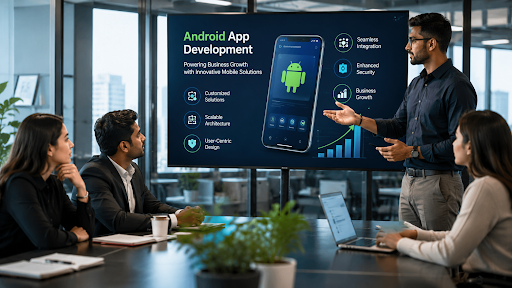
For business owners evaluating an app project for the first time, what is Android app development is a reasonable question that rarely gets a straight answer. Android development is the process of building software that runs natively on Android devices, using Kotlin as the primary programming language and Android Studio as the development environment. Unlike web development, which produces software that runs in a browser, Android development produces an application installed on the device itself, with access to the device’s hardware features, camera, GPS, Bluetooth, NFC, offline storage, and push notifications, that a browser-based experience can’t fully replicate.
The development process covers the frontend, the screens and interactions users see, the backend, the server infrastructure handling data storage, user accounts, and business logic, and the integration layer connecting the app to existing business systems like inventory management software, payment gateways, and delivery tracking services. Each layer has its own technical requirements and its own timeline contribution, and the total project scope reflects all three rather than just the visible screens.
Platform choice matters for strategy as well as technology. Android’s market share in most of sub-Saharan Africa, South and Southeast Asia, and Latin America makes it the unambiguous priority platform in those markets. In markets with more balanced iOS and Android adoption, cross-platform frameworks like Flutter or React Native let a single codebase serve both platforms, which affects both the build timeline and ongoing maintenance cost.
Where an Android App Creates Operational Leverage
The businesses that get the clearest ROI from Android apps tend to be the ones using them to solve specific operational problems rather than to add a digital presence for its own sake.
Field workforce management is one of the clearest examples. A company with staff in the field, delivery drivers, service technicians, sales representatives, gains significant operational leverage from an Android app that replaces phone calls and paper forms with digital job assignment, real-time status updates, and automatic data capture. The productivity gain from eliminating the communication overhead around field operations tends to be measurable within months of deployment.
Customer self-service reduces support costs in proportion to how much of that support previously required human handling. An app where customers can track orders, manage returns, update preferences, and resolve common issues without calling anyone frees staff time for the cases that actually require human judgment. Dara’s team had been fielding dozens of calls per day from customers asking about order status. The app’s order tracking feature reduced that volume significantly in the first month.
Inventory and supply chain visibility gives business owners and managers real-time operational data that paper-based systems or delayed reporting can’t provide. An Android app connected to inventory systems lets a manager see stock levels from anywhere, approve purchase orders from a phone, and receive alerts when key items fall below threshold, which compresses decision cycles that previously took days.
The Integration Layer Nobody Talks About in the Pitch
Apps that live in isolation from existing business systems create parallel data entry problems that often make the overall operational situation worse rather than better. A customer-facing app that doesn’t connect to the inventory system will show customers products that are out of stock. A field service app that doesn’t sync with the billing system creates a reconciliation job for the accounts team every month. The integration layer, connecting the app to the existing software ecosystem of a business, is where a significant portion of real project complexity lives and where the difference between an experienced development team and an inexperienced one becomes most visible.
Dara’s app needed to connect to her inventory management system and her existing payment processor. The inventory integration took longer than anyone expected because the documentation for her system’s API was incomplete and required reverse engineering certain endpoints. A development team that had navigated similar integration challenges before managed it without treating it as a project crisis. A team encountering it for the first time would have.
Post-Launch Is Where the Real Work Happens
An Android app that launches is a hypothesis, not a finished product. The first version reflects assumptions about how users will behave, most of which will be at least partially wrong. The data from real users in production, what they do, where they drop off, what they don’t use, what they struggle with, is what shapes the second version into something that actually fits how people use it.
Google Play Console provides behavioral data, crash reports, and performance metrics that tell a development team and a business owner specifically where the app is underperforming and why. Acting on that data, with a development partner who remains available post-launch rather than disappearing after handoff, is the difference between an app that improves over time and one that stagnates.
What Changed for Dara
Eighteen months after launch, her repeat order rate from app users is higher than her overall repeat order rate had been before the app. Her customer service call volume around order status is down considerably. She’s planning a second phase with a field sales module for her account managers and a wholesale ordering portal for her business customers, both of which use the same backend infrastructure the consumer app already runs on.
The app didn’t fix her supply chain inefficiencies or her training gaps. Those required different interventions. What it did was change the competitive dynamic in her market by giving her customers a reason to reorder through her rather than exploring alternatives. That was the strategic goal. The technology was how she achieved it.